-
Introduction
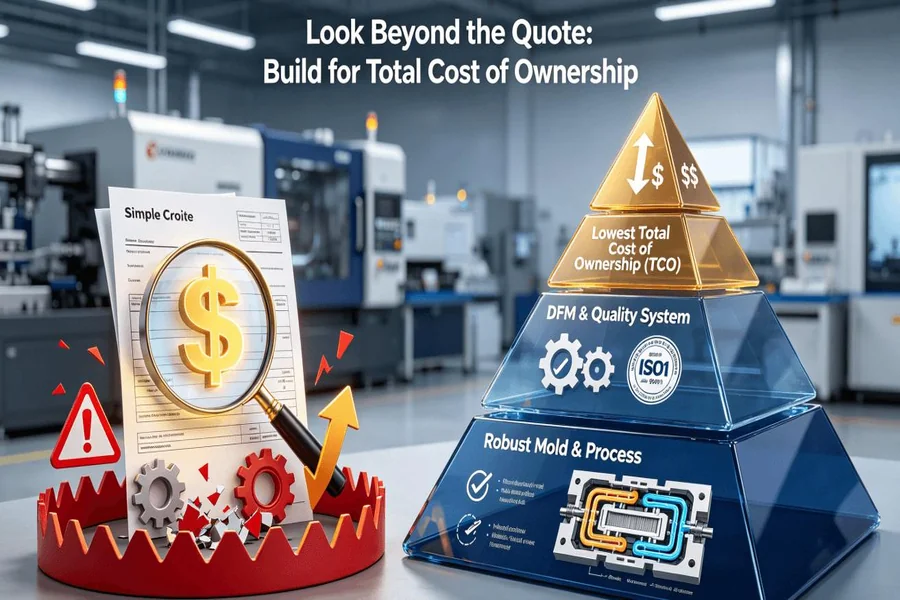
In the quest for plastic injection molding services, businesses often receive a quote and focus solely on the bottom-line price. This narrow view can obscure hidden long-term cost risks buried in the details: frequent Engineering Change Notice (ECN) charges, secondary expenses from premature mold failure, or batch scrap due to unstable processes. The root cause lies in traditional quoting that may skip critical upfront Design for Manufacturability (DFM) analysis and lacks transparency in a supplier’s process control, material traceability, and quality management systems.
This article systematically breaks down the components of a professional quote, providing a framework to assess everything from supplier credentials and mold design to material selection and trial reports. So, how can one develop a discerning eye to identify a truly reliable partner with a superior Total Cost of Ownership (TCO) from a maze of quote details?
What Core Elements Should a Comprehensive Plastic Injection Molding Quote Include?
A professional plastic injection molding quote transcends a simple “unit price × quantity” calculation. It is a detailed project blueprint that mitigates risk. A comprehensive quote must encompass: a detailed part analysis with wall thickness and draft angle review; DFM (Design for Manufacturability) feedback to prevent costly modifications; a clear breakdown of mold cost with life expectancy (e.g., 500k shots); full material specifications and source documentation; phase-by-phase lead times; post-processing options and associated costs; explicit quality control standards (e.g., per ISO 2768-m); and unambiguous payment terms. Crucially, DFM analysis should be a prerequisite for quoting, not a paid add-on, as it is the key to avoiding downstream ECN costs. This level of detail is the hallmark of a supplier practicing responsible On-Demand Manufacturing, where clarity from the start defines the partnership.
How to Identify a Reliable Plastic Injection Molding Service Provider, Not Just a Low-Cost Vendor?
Selecting a partner requires a multi-dimensional assessment beyond price. A credible supplier demonstrates proven capability across technical, qualitative, and operational spectrums.
Technical and Certification Benchmarks
True capability is validated by credentials, not claims. Suppliers should hold relevant international quality certifications like ISO 9001, IATF 16949 (automotive), or AS9100D (aerospace), which mandate disciplined process control. Precision Manufacturing is demonstrated through the ability to handle complex geometries, tight tolerances, and advanced materials. A reliable partner will readily provide First Article Inspection (FAI) reports and scientific molding data—such as process parameter curves—as objective evidence of control, moving beyond verbal assurances.
Evaluating Capability Through Assets and Experience
Assessing a provider’s equipment portfolio and industry experience is vital. Modern, well-maintained machinery with adequate tonnage range and auxiliary equipment (e.g., temperature controllers, robots) indicates production stability. Reviewing case studies, especially in demanding sectors like automotive, medical, or consumer electronics, offers tangible proof of competency. Understanding a supplier’s specialization helps match project needs; for instance, how to find reliable plastic injection moulding service involves knowing if they excel in high-volume production or rapid prototyping. Familiarity with different process types, such as those outlined in A Detailed Guide to 5 Major Types of Injection Molding, can also indicate technical breadth.
- Proactive Engineering Support:A reliable partner engages early, offering free DFM analysis to optimize the part for production, showcasing a commitment to project success rather than just winning an order.
- Supply Chain Integrity:They provide full material certifications (e.g., UL, FDA, RoHS) and demonstrate traceability, ensuring every batch meets specified standards—a non-negotiable aspect for regulated industries.
How Do Mold Design and Steel Selection Impact Your Long-Term Per-Piece Cost?
The mold is a critical, long-term asset. While it represents a significant upfront cost in a quote, its design and construction directly dictate per-part economics in mass production. A custom plastic injection molding service must transparently discuss mold strategy. The choice of steel—for example, P20 for shorter runs versus hardened S136 for high-volume, corrosion-resistant applications—directly affects mold life and maintenance frequency, impacting the total cost over the tool’s lifespan
Advanced mold design features are investments that reduce recurring part cost. Hot runner systems minimize material waste and cycle times. Conformal cooling channels promote uniform cooling, reducing part warpage and improving quality consistency. While these features increase mold cost, they significantly lower the per-piece price in high-volume production by boosting efficiency and yield. Therefore, evaluating a plastic injection service requires a TCO perspective: a higher initial investment in a robust, well-designed mold often translates to a lower and more predictable cost per part over the entire production lifecycle.
After Receiving a Quote, What Are the Next Steps to Communicate and Verify Supplier Capability?
Securing a quote is merely the first step. A systematic approach to validation is crucial for de-risking the project. The process of how to choose a custom plastic injection molding service involves active verification, not passive acceptance.
Conduct a Detailed Quote Interrogation
Engage the supplier with specific, technical questions about their quotation. Request clarification on tolerance justifications, the origin of material certificates, the basis of cycle time estimates, and the specifics of their quality inspection plan. A competent supplier will provide clear, engineering-backed rationale for every line item.
Witness the Process and Scrutinize Data
Whenever possible, request to witness a mold trial, either remotely or on-site. Focus on process stability—consistent cycle times, steady pressures, and temperatures. After the trial, demand a comprehensive report that goes beyond a simple “pass/fail.” It should include a complete dimensional First Article Inspection (FAI) report and statistical Process Capability (Cpk) analysis for critical dimensions. This data-driven approach is the cornerstone of scientific molding. For a structured approach, refer to A Complete Step-by-Step Guide to Obtaining a Plastic Injection Molding Quote.
- Define Acceptance Criteria:Before production begins, formally agree on the part acceptance criteria, including which dimensions are critical, allowable defect rates (AQL), and packaging standards.
- Secure IP and Contract Terms:Ensure a robust Non-Disclosure Agreement (NDA) and a clear contract that covers mold ownership, liability for delays or defects, and terms for engineering changes.
What Localized Advantages and Challenges Should Be Considered When Sourcing Injection Molding in China?
Sourcing plastic injection molding in China offers distinct advantages: competitive cost structures, rapid prototyping and production turnarounds, and an unparalleled, vertically integrated supply chain for materials and components. This ecosystem is ideal for On-Demand Manufacturing, providing flexibility to scale production up or down in response to market demand. However, challenges such as communication barriers, time zone differences, and potential variations in quality interpretation can arise.
To navigate these, seek suppliers that mitigate these challenges proactively. Prioritize those with dedicated, fluent English-speaking engineering support to ensure precise technical communication. Opt for partners with transparent, digital project management platforms that provide real-time production progress updates. Furthermore, a supplier with certifications like ISO 14001 (Environmental Management) not only demonstrates a commitment to sustainability but also indicates a higher level of operational discipline and standardization, which indirectly correlates with consistent quality and reliability. The key is to partner with a plastic injection molding china supplier that operates with international standards of transparency and communication, effectively turning geographic advantages into seamless operational benefits.
Conclusion
Evaluating a plastic injection molding quote is fundamentally an assessment of a supplier’s comprehensive capabilities and project risk management. Looking beyond the price to scrutinize DFM input, process data, quality systems, and mold strategy is essential for project success and achieving true total cost optimization. A meticulous approach in the selection phase prevents costly surprises during production.
Author Bio
Zhang Wei, a precision manufacturing and supply chain expert with over 10 years of experience, specializes in injection molding and mold technology. He has provided manufacturing solution optimization consulting for multiple Global 500 companies.
FAQs
Q1: What files are typically needed to obtain a plastic injection molding quote?
A: At a minimum, provide 3D CAD files (STEP/IGS format), 2D drawings with critical dimensions and tolerances, material specifications, surface finish requirements, and estimated annual volume. More detailed requirements lead to a more accurate quote.
Q2: Mold cost is a significant part of the quote. Can molds be leased to reduce initial investment?
A: This depends on the supplier’s business model. Some offer “mold cost amortization” or installment plans. However, mold ownership affects long-term pricing and modification flexibility. Purchasing the mold, while a higher upfront cost, is often more economical for long-run, large-scale production.
Q3: How can one verify if a supplier truly practices scientific molding?
A: Request to review their mold trial report. It should include recorded process parameters like fill time, packing pressure curves, and mold temperature distribution, along with a dimensional statistical process control (SPC) analysis report—not just a simple pass/fail statement.
Q4: Can small-batch orders (e.g., under 1,000 pieces) receive competitive quotes?
A: Yes. Suppliers specializing in on-demand manufacturing and rapid prototyping often use standardized processes, shared molds, or aluminum tooling to make small batches cost-effective. Inquire directly about their solutions for low-volume production.
Q5: Do environmental certifications (e.g., ISO 14001) directly impact the quality of injection molded parts?
A: They do not directly dictate the quality of a single part but reflect the factory’s management standardization and commitment to sustainable manufacturing. A certified factory typically has more systematic controls over raw materials, waste management, and process stability, indirectly ensuring long-term production consistency.
Demystifying Injection Molding Quotes 5 Key Points to Help You Save 30% on Procurement Costs

By Aaron
Published On: April 13, 2026
 Follow on Facebook
 Join WhatsApp Channel