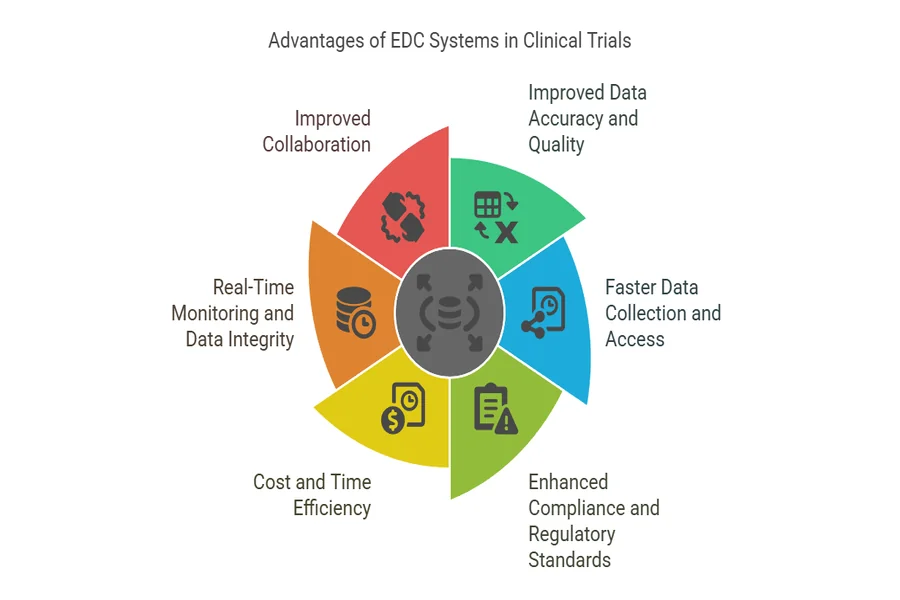
Clinical research generates enormous volumes of data, and the way that data is collected, validated, and stored often decides whether a study finishes on time and survives regulatory scrutiny. For decades, sponsors relied on paper case report forms, manual transcription, and endless rounds of query resolution. That model no longer scales. Today, electronic data capture systems sit at the center of nearly every well-run study, turning fragmented, error-prone data collection into a controlled, real-time, audit-ready process. Understanding how these platforms work — and how a contract research organization deploys them — is essential for any sponsor planning a modern trial.
What Electronic Data Capture Actually Does
An electronic data capture (EDC) system is software that replaces paper case report forms with structured electronic case report forms (eCRFs). Site staff enter patient data directly into the platform, where it is immediately validated against predefined rules, stored in a secure database, and made available to monitors, data managers, and statisticians. Instead of waiting weeks for paper forms to travel from a site to a central office, teams see the data almost as soon as it is recorded.
The core value of an EDC platform lies in three functions working together. First, it enforces data integrity at the point of entry through pre-validation: when a value falls outside an acceptable range, the system flags or rejects it before the record is saved. Second, it maintains a complete audit trail, logging previous values, timestamps, and the reason for every change — a requirement that manual systems simply cannot satisfy reliably. Third, it centralizes access so that every stakeholder works from a single source of truth, eliminating the version-control chaos that plagues spreadsheet-based studies.
Why Data Quality and Compliance Depend on the Right Platform
Regulators expect clinical data to be attributable, legible, contemporaneous, original, and accurate — the ALCOA principles. A properly validated EDC system builds these expectations into the workflow rather than relying on human diligence alone. Compliance with 21 CFR Part 11, the U.S. regulation governing electronic records and electronic signatures, is a baseline requirement for platforms used in trials intended for FDA or EMA submission. That means role-based access control, secure authentication, session timeouts, immutable audit trails, and electronic signatures reserved for authorized investigators.
Beyond the regulation itself, validation frameworks such as GAMP5 and Good Clinical Data Management Practices (GCDMP) govern how the software is configured, tested, and documented. A credible CRO can supply a full validation documentation package on request, demonstrating that the system behaves as intended and that any customization was tested before going live. Without this documentation, a sponsor risks findings during an inspection that can delay a submission or invalidate data entirely. This is precisely why the choice of platform is not a purely technical decision — it is a risk-management decision that shapes the regulatory outcome of the entire program.
 Follow on Facebook
 Join WhatsApp Channel
How a CRO Turns an EDC Platform Into an Operational Advantage
Technology alone does not run a study. The real advantage appears when an experienced team configures, validates, and operates the platform around a specific protocol. In well-managed cro clinical trials, the EDC system is tailored to the study design rather than forcing the study to bend around a rigid, off-the-shelf tool. A dedicated data management team annotates the case report forms, builds the visit and form structure, defines validation rules, configures randomization and stratification, and integrates safety reporting so that adverse events trigger automatic notifications to pharmacovigilance.
This integration is where efficiency compounds. Real-time access to incoming data allows monitors to apply risk-based monitoring, focusing their attention on the sites and data points that carry the greatest risk instead of verifying every field uniformly. Source data verification becomes targeted and proportionate. Data managers clean records continuously rather than in a frantic push before database lock. Statisticians can plan and pressure-test their analyses earlier because the data arrives in a structured, export-ready format compatible with their tools. The cumulative effect is shorter timelines, lower monitoring costs, and higher data quality — the three outcomes every sponsor wants and the three that a fragmented, paper-based approach consistently undermines.
Matching the System to the Study Type
Not every trial has the same data needs, and a mature EDC capability reflects that. An interventional Phase II–IV trial demands multi-site support, integrated randomization, granular monitor access rights, and rigorous automated pre-validation. A large late-phase or observational study, by contrast, prioritizes scalability across hundreds of investigators and tens of thousands of patients, simplified adverse-event workflows suited to real-world evidence, and dashboards that summarize enrollment at a glance. Disease and product registries need yet another configuration: long or indefinite timelines, automatic identification of existing patient records, and secure transfer of records between physicians.
A platform built to serve these distinct scenarios — with editions or configurations designed for each — spares the sponsor from compromising on either flexibility or compliance. It also removes a hidden burden: sponsors working with a fully supported system do not need to hire and manage a separate data-management function, because that expertise is embedded in the CRO’s delivery model.
The Bottom Line for Sponsors
Choosing an EDC platform is really about choosing how much control, speed, and compliance confidence you want in your study. A generic, loosely supported system may look inexpensive at first, but the cost surfaces later in queries, delays, and inspection findings. A validated, protocol-specific platform operated by an experienced data-management team does the opposite: it front-loads the discipline, keeps the study audit-ready from day one, and lets the scientific and clinical teams focus on what actually matters — the evidence.
For sponsors planning a new study or reassessing how their current trial handles data, the right first step is a conversation with a team that has configured these systems across therapeutic areas and study types. If you want to understand how a purpose-built EDC platform could streamline your next trial, reach out to the Pharmaxi team for a free consultation and a walkthrough tailored to your protocol.